
Iris Leaf Quilt Block
And some work that I enjoy…

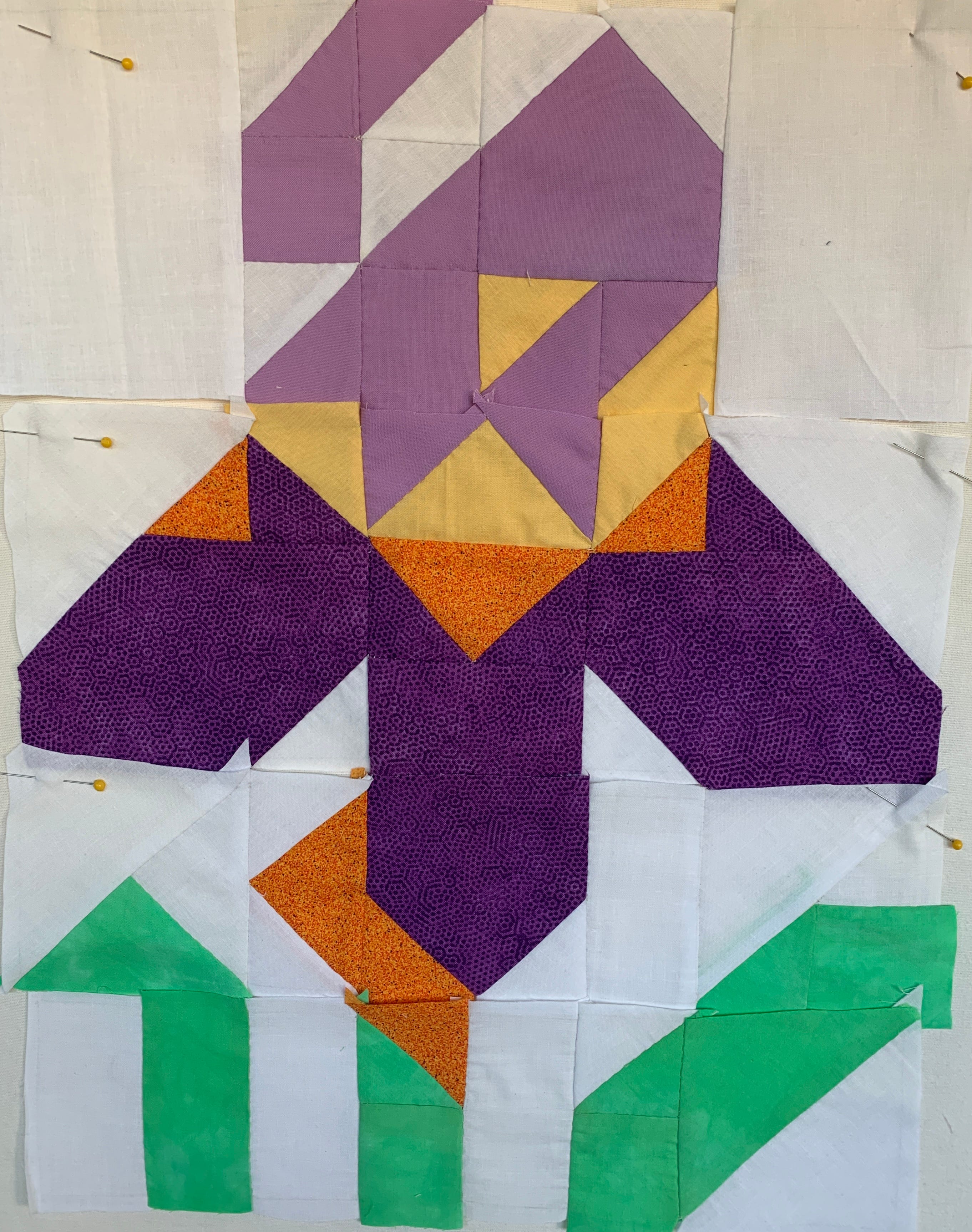
I am in the process of creating a new lecture. It has been brewing in my head for a couple of years and I have been slowly accumulating the research I needed to tell a coherent story about a certain movement in quilting history. Along with that, I planned to combine stories about some of my favorite quilt designers along with it. Yes, it is the Superstar Quilters of the 1930’s, Ruby Short McKim, Eveline Foland, Laura Wheeler, and Ann Orr.
All these ladies helped to move quilting to a new level by showing that “women’s work” can be lucrative and actually make money for the many working but unpaid women (also know as housewives) who needed to earn some income during the Great Depression. With the help of newspapers and “women’s” magazines, they turned a hobby into an art and showed the American public that quilting can be both art and a profitable business.
Before this era, patterns for patchwork blocks and quilting designs were passed from mothers to daughters and to community members mostly by word of mouth. If a quilter saw a pattern she/he liked, chances are the designer would pass on the pattern by just describing the process used to create it. Such directions as “make a 9 patch block and cut it into thirds” or “trace around the small saucer and overlap the circles” was all that was needed to give a neighbor the latest quilt pattern. In 1835 an actual quilt pattern was published in Godeys Ladies Book, a popular magazine for middle and upper class ladies. It wasn’t until the early 1900’s that newspapers started to publish quilt patterns. The Kansas City Star is the most famous of these. However actual size patterns were not published until the 1920’s, meaning templates drawn to size were finally printed so a quilter could cut them out of the newspaper and trace around them to create the pictured block. And the designer that developed that concept was Ruby Short McKim.


You might know Mrs. McKim from her book “101 Patchwork Patterns” originally published in 1931. For years it was the Bible of quilt making. I found her book in the library while searching for any information I could find on how to hand piece quilt blocks. Her designs were a combination of traditional styles with Art Deco touches and they caught my eye. (See more about Mrs. McKim in my Substack “One of My Quilting Heroines” Link.). I was able to find a few of her embroidery designs on line then but most of the quilt related information I found were photos of her columns published in the Kansas City Star. I also found copies of her catalogs for sale on EBay along with her original columns cut out from newspapers. It was a real treasure trove.
This was among the ephemera I purchased.


It seems that Mrs. Feldman sent her request for the pattern to the Pacific Northwest Farm Trio newspaper who probably published a syndicated quilting column. She received the instructions and templates for Ruby Short McKim’s Iris quilt block that was published in June of 1931 and called Iris Leaf.
Part of my plan for this lecture was to make some of the patchwork blocks from the Kansas City Star syndicated columns in order to show what quilters in the 1930’s were doing. So I decided to try to follow the 1930’s instructions and sew this block together.
I usually don’t have a very successful time using templates to cut out block pieces. I either make the pieces too wonky due to bias stretching or I am not careful enough when I trace around the template. The fabric slips too much and I get an inaccurate piece. A sandpaper board helps to hold the fabric securely, but for some reason I was just too lazy to find my sandpaper board and use it for this endeavor. Also, I tend to traces pieces on the wrong side of the fabric and have to cut them again.
I have to admit that 1930’s patterns are not geared towards helping you to successfully create the block. The designers don’t tell you how to sew the various blocks into sections so you can concentrate on doing straight line seams. They just sketch out the block, mark the various blocks with the colors suggested and expect you to take it from there. The quarter square triangles in this pattern are 3 different sizes and it is up to you to figure out which size to use where. Some times you just make a guess and find out later, when the block ends up the wrong size, that you guessed wrongly.
I decided to piece this block section by section. It’s a large block, 13 1/2” by 17” and I roughly followed the printed pattern for the layout. I guessed there were three smaller sections pieced together to form four larger sections. Lastly the four sections were sewn together for the finished block.


If you attempt to sew this block make sure you are familiar with patchwork. It is not a block for beginners. I made approximately 20 mistakes trying to do it including measuring the templates and then cutting the wrong size because I forgot to add the seam allowance, a very rookie mistake. Then I used the wrong piece in the middle of the second section and had to take it apart. I cut the small square pieces the wrong size, tried to use them anyway, and then took an entire section apart to repair the mistake. I could go on and on. All I could do is hit myself in the forehead with an unprintable exclamation.
So all my good intentions of showing a completed block went to the wayside and all I could get finished were the 4 sections themselves. Take a look at my Instagram (#pattieklimek) for a peek at the completed block. Hopefully I can post it on Sunday or Monday.
A short promo: If you are a member of the Champlain Valley Quilt Guild in Burlington VT, you will get the premiere of this lecture in January over Zoom. I can’t wait to meet you all for this and my Make a Japanese Rice Bag, Komeburkuro, workshop the following weekend.
Your description of the instructions in those old patterns doesn't surprise me at all. I've seen knitting patterns from the same era, and I used to have a copy of the Frances (Fanny?) Farmer cookbook from around the turn of the 20th century. What they have in common is that they assume you've already learned the basics from the older women in your family/community, so all you need from this pattern is how to do this particular pattern/recipe. So yeah, they don't give details about how to do the basics, like press the seams open or to the side, or assembly sequence; they assume you know how to do that.
Ruby McKim's "101 Blocks" book was one of the first quilting books I got when I was learning (this was way before the internet, so no such thing as YouTube video tutorials). I loved that book, not only because I love her designs, but also because (IIRC) her instructions were more helpful to a newbie, e.g., instead of "put sections A and B together, then add section C," it was more like "here's how these three sections go together."